

What Is CPTaaS and Why It’s Replacing Traditional Pentesting
Continuous Penetration Testing as a Service (CPTaaS) moves security validation from a calendar event (scheduled once or twice a year, delivered weeks later as a static PDF) into a program that runs in lockstep with how your environment actually changes.
The shift is overdue. Traditional pentests were designed for a world where infrastructure changed slowly. That world no longer exists. Development teams push updates daily. Cloud environments spin up new assets without notice. Acquisitions add inherited attack surfaces overnight. An annual pentest captures a snapshot of a moment that may no longer represent your real risk exposure.
The market reflects this urgency. The global penetration testing market was valued at approximately $2.74 billion in 2025 and is projected to reach $7.41 billion by 2034, driven almost entirely by demand for continuous and platform-driven testing models. Organizations that test continuously find more vulnerabilities, fix them faster, and maintain a security posture that reflects today, not eleven months ago.
Industry analysts have formalized this shift. Continuous Offensive Security Testing (COST) is now a defined discipline, distinct from legacy periodic pentesting. The framework describes a cyclical program built around four phases (Design, Build, Run, and Improve) where testing is triggered by meaningful change rather than calendar dates. High-risk triggers like new publicly exploitable exposures or zero-day alerts should initiate a testing cycle within 72 hours; medium-risk changes like pre-production code commits within seven days. Annual assessments simply cannot support this cadence.
The projection is clear: by 2028, the majority of enterprise pen test programs are expected to operate as continuous validation integrated into DevSecOps pipelines, replacing annual assessments as the primary proof of resilience.
What distinguishes CPTaaS from traditional PTaaS is genuine continuity. Many vendors market themselves as continuous when they really mean “on-demand”: the scope is still fixed, the customer still initiates each engagement, and findings still arrive after the fact. True CPTaaS means testing is triggered by change, ongoing by design, and integrated into how your security program operates day to day. The components that make this work are:
- Continuous attack surface monitoring: knowing what you have, including assets you didn’t know existed
- Change-triggered testing: when your environment shifts, validation runs automatically, not on the next scheduled engagement
- Expert human validation: experienced pentesters confirm real-world exploitability, not just automated scanner noise
- Live findings: results feed directly into remediation workflows, not a report that arrives three weeks later
This guide covers the ten companies that best represent what CPTaaS actually looks like in 2026, covering platforms and services that go beyond scheduling flexibility and deliver genuine continuous coverage.
Why the Urgency for CPTaaS Has Never Been Greater
Three converging forces have made continuous testing not just preferable but operationally necessary in 2026.
Attackers now move faster than annual testing cycles can respond.
CrowdStrike’s 2026 Global Threat Report documented an 89% increase in AI-enabled attacks and recorded average attacker breakout times dropping to just 29 minutes from initial access to lateral movement across the network. In that context, an organization that tests its defenses once a year and spends the other 51 weeks hoping nothing changed is not running a security program. It is running a wishful thinking program. A finding that would have been caught in February is exploitable by March if nothing triggers a test in between.
The vulnerability surface is expanding faster than any team can manually review.
In 2025 alone, 48,185 new CVEs were disclosed, a 20% increase over 2024, and that number captures only formally catalogued vulnerabilities. AI-assisted development has quietly made things worse. More than 30% of new code in enterprise environments is now AI-generated, and developers who were never trained as security engineers are shipping features at a pace no quarterly pentest can keep up with. Every deployment that goes untested is an open question about whether something exploitable just went to production.
Regulations are shifting from annual checkboxes to continuous assurance.
PCI DSS v4.0, which became fully mandatory in March 2025, requires testing after any significant infrastructure change, not just on an annual calendar. The EU’s Digital Operational Resilience Act (DORA) and NIS2 directive impose continuous monitoring and resilience testing obligations on financial institutions and critical infrastructure operators across Europe. HIPAA guidance increasingly expects ongoing technical safeguard validation rather than periodic reviews. The regulatory floor is rising toward what continuous programs have always offered: evidence that your defenses work right now, not as of last year’s assessment date.
These are not reasons to buy a particular vendor. They are the reasons the entire annual-pentest model is being replaced, and why organizations evaluating CPTaaS providers in 2026 are not buying a convenience upgrade. They are closing a structural gap in how security validation actually works.
How We Evaluated These Companies
Ranking CPTaaS providers is not a matter of listing the largest vendors or most-recognized brands. Several of the biggest names in cybersecurity are in this guide, but size alone doesn’t mean a vendor operates as a true continuous testing partner. We evaluated each provider against five criteria:
1. Genuine continuity. Does testing trigger automatically when the attack surface changes, or does the customer still initiate each engagement? True CPTaaS means the program never stops between engagements.
2. Human expert quality. Automated scanners generate findings. Experienced human testers confirm exploitability, discover business logic flaws, and chain vulnerabilities into real attack paths. We weighted depth and qualifications of human testing staff heavily.
3. Attack surface management integration. Can the platform see your full external footprint (including shadow IT, acquired assets, and new cloud infrastructure) rather than the scope defined at kickoff?
4. Real-time findings and remediation workflow. Does the platform deliver findings as they are discovered, with integrations into your existing tools (Jira, ServiceNow, Slack)? Or does everything arrive at the end in a PDF?
5. Compliance and reporting depth. Can the platform generate evidence-ready reports for SOC 2, PCI DSS, HIPAA, ISO 27001, and similar frameworks, generated from live data rather than a point-in-time snapshot?
We also considered independent analyst recognition, including positions in the GigaOm Radar for PTaaS and Gartner’s vendor landscape for continuous offensive security testing.
The Top 10 CPTaaS Companies
1. Sprocket Security
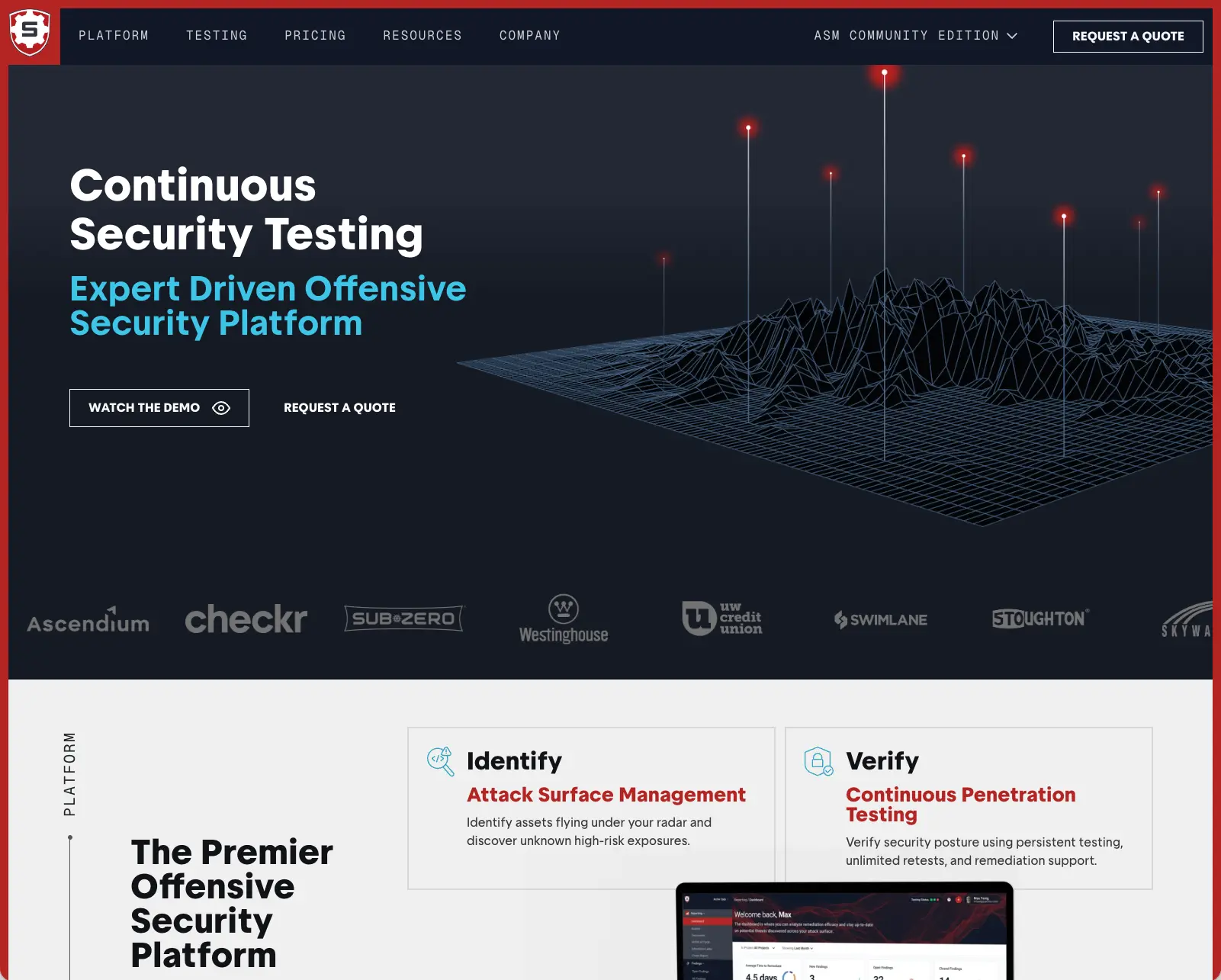
Sprocket Security continuous penetration testing platform
Headquarters: Madison, WI | Founded: 2018 | Best for: Organizations that need a true continuous program, not a scheduled service rebranded as continuous
Overview
Sprocket Security was built from the ground up around continuous testing before it became an industry category. The company’s approach centers on a straightforward premise: your security posture should reflect today, not the last time you scheduled a test. Sprocket combines continuous attack surface monitoring with persistent, expert-driven penetration testing and real-time change detection to deliver a program that never stops.
The platform starts with free Attack Surface Management (ASM), giving organizations a permanent, attacker-eye view of their external footprint at no cost. From there, Sprocket’s continuous testing model triggers expert-led testing automatically when new assets appear, infrastructure changes, or new vulnerabilities emerge. No scheduling. No 345-day gap between tests. Coverage that keeps pace with your environment.
What separates Sprocket from every other provider on this list is the combination of genuine continuity and genuine human expertise. Sprocket does not use crowdsourced researcher pools or rotate testers between engagements. Dedicated US-based pentesters work persistently on customer environments. They know your architecture, your risk profile, and your history. That continuity of expertise is what turns findings into real security improvement rather than just a list of CVEs to triage.
Sprocket is also recognized in Gartner’s vendor landscape for continuous offensive security testing, covering both PTaaS and red teaming capabilities, one of a small number of vendors with that dual recognition.
Key capabilities:
Capability | Detail |
|---|---|
Attack Surface Management | Continuous external discovery, including shadow IT, acquired assets, and forgotten subdomains. Permanently free tier available |
Continuous Penetration Testing | Testing triggers automatically on detected change, not on a fixed calendar |
Unlimited Retests | Remediate and retest without scheduling delays or surprise invoices |
Compliance Reporting | On-demand SOC 2, PCI DSS, HIPAA, and ISO 27001 evidence generated from live data |
Integrations | Jira, Slack, and existing security toolchains |
Testing coverage: External networks, internal networks, web & API applications, social engineering campaigns, cloud environments
Who it’s for: Organizations that are done with the annual-test cycle and want a security program that actually reflects their current environment. Sprocket is equally suited to mid-market companies and enterprises. The platform scales without the overhead of managing a large crowdsourced community.
What a Sprocket engagement actually looks like:
The program starts with ASM, which is free and takes minutes to configure. Sprocket maps your external attack surface immediately and flags any exposures visible from the internet before a single pentest has been scoped. From that baseline, the continuous testing program runs in the background. When Sprocket’s change detection identifies a new subdomain, an open port that wasn’t there before, a new cloud asset, or a vulnerability that matches your environment, testing is automatically triggered rather than waiting for your next check-in.
Findings arrive in the portal as they are discovered, categorized by severity, with reproduction steps and remediation guidance written for engineers, not just executives. Retests are unlimited for individual findings and built into the subscription, so when your team fixes something, a Sprocket tester verifies the fix without you needing to schedule a new engagement or absorb another cost. Compliance reports are generated on demand from live data, which means your SOC 2 auditor gets a report reflecting the current state of your program rather than a six-month-old point-in-time snapshot.
Pricing: Permanently free ASM tier. Continuous penetration testing programs are subscription-based, scoped to the organization’s environment. Request a quote →
In one sentence: Technology-powered. Human-verified. Continuous by design, not by marketing copy.
2. Cobalt.io
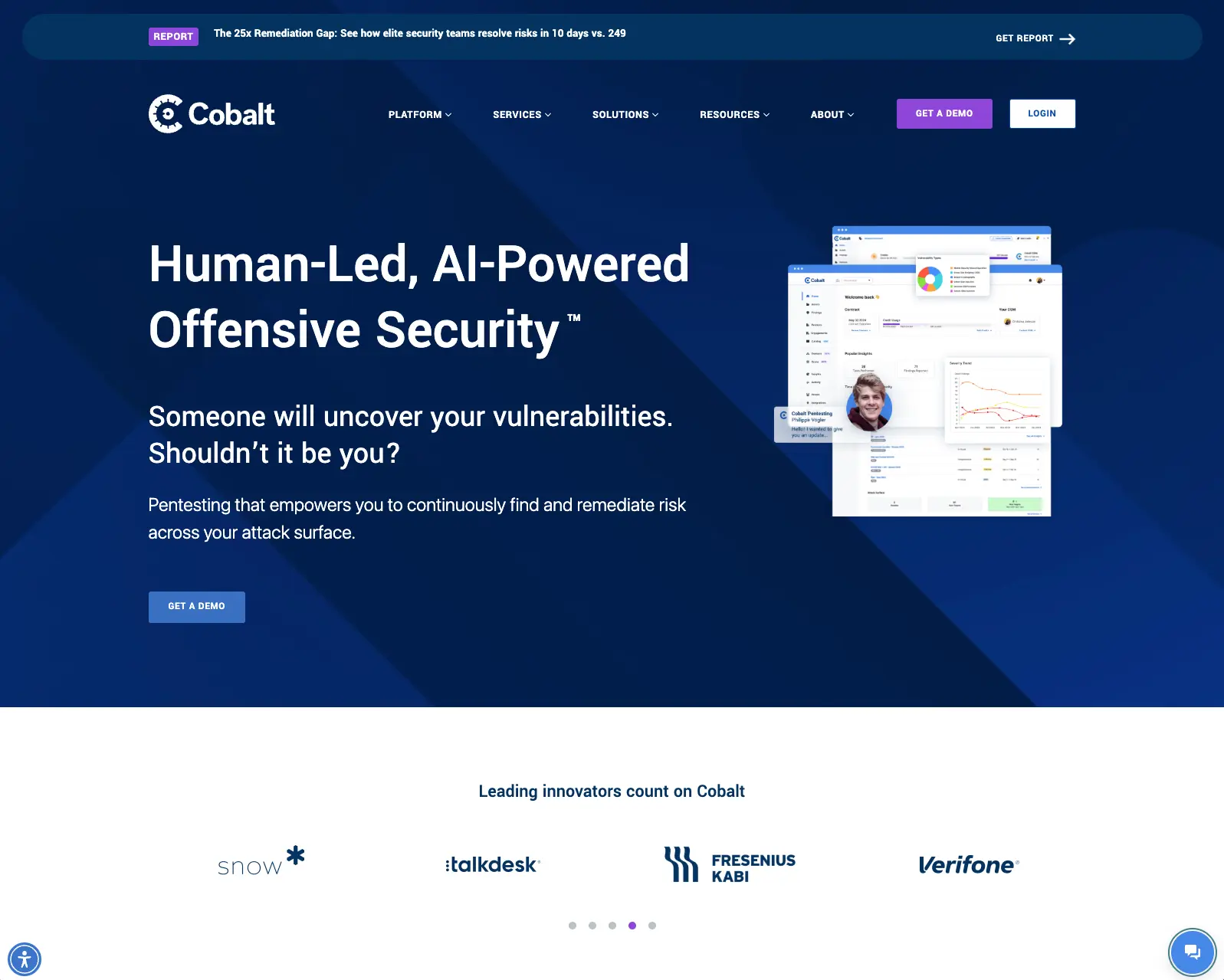
Cobalt.io Offensive Security Platform
Headquarters: San Francisco, CA | Founded: 2013 | Best for: Mid-to-large enterprises adopting a platform-driven offensive security program with mature in-house security teams
Overview
Cobalt pioneered the modern PTaaS model and has evolved significantly since then. The Cobalt Offensive Security Platform now combines 500+ vetted pentesters with AI-powered reconnaissance, automated vulnerability discovery, and continuous scanning, all delivered through a centralized platform that integrates with 50+ tools.
In 2025 and early 2026, Cobalt released a series of AI capabilities including automated recon, AI-powered vulnerability discovery, and natural-language reporting, built on a decade of proprietary exploit intelligence from thousands of engagements. The platform earned recognition as a Leader in the GigaOm Radar for PTaaS and has been named in Gartner’s Hype Cycle reports for Application Security, Security Operations, and XaaS for three consecutive years.
Cobalt’s credit-based model gives organizations flexible testing capacity across web applications, APIs, mobile, networks, and cloud, with pentests launchable in as little as 24 hours.
Strengths:
- Deep library of proprietary exploit intelligence built over 10+ years
- AI now automates reconnaissance and initial vulnerability discovery, so human testers focus on complex attack paths
- Recognized Leader and Fast Mover in GigaOm’s PTaaS Radar three years running
- Rated exceptional for flexibility, speed, and risk reduction in GigaOm’s business criteria comparison
Limitations:
- Credit-based pricing can become unpredictable at scale, and some organizations find the model adds friction compared to subscription-based continuous programs
- Platform complexity favors mature security teams; smaller organizations with limited in-house bandwidth may find the management overhead significant
- The crowdsourced tester pool, while vetted, means less continuity of tester expertise on individual environments compared to dedicated-team models
Best for: Enterprises with active security programs that want a mature, AI-enriched platform for managing continuous pentesting across multiple assets and teams.
3. Outpost24
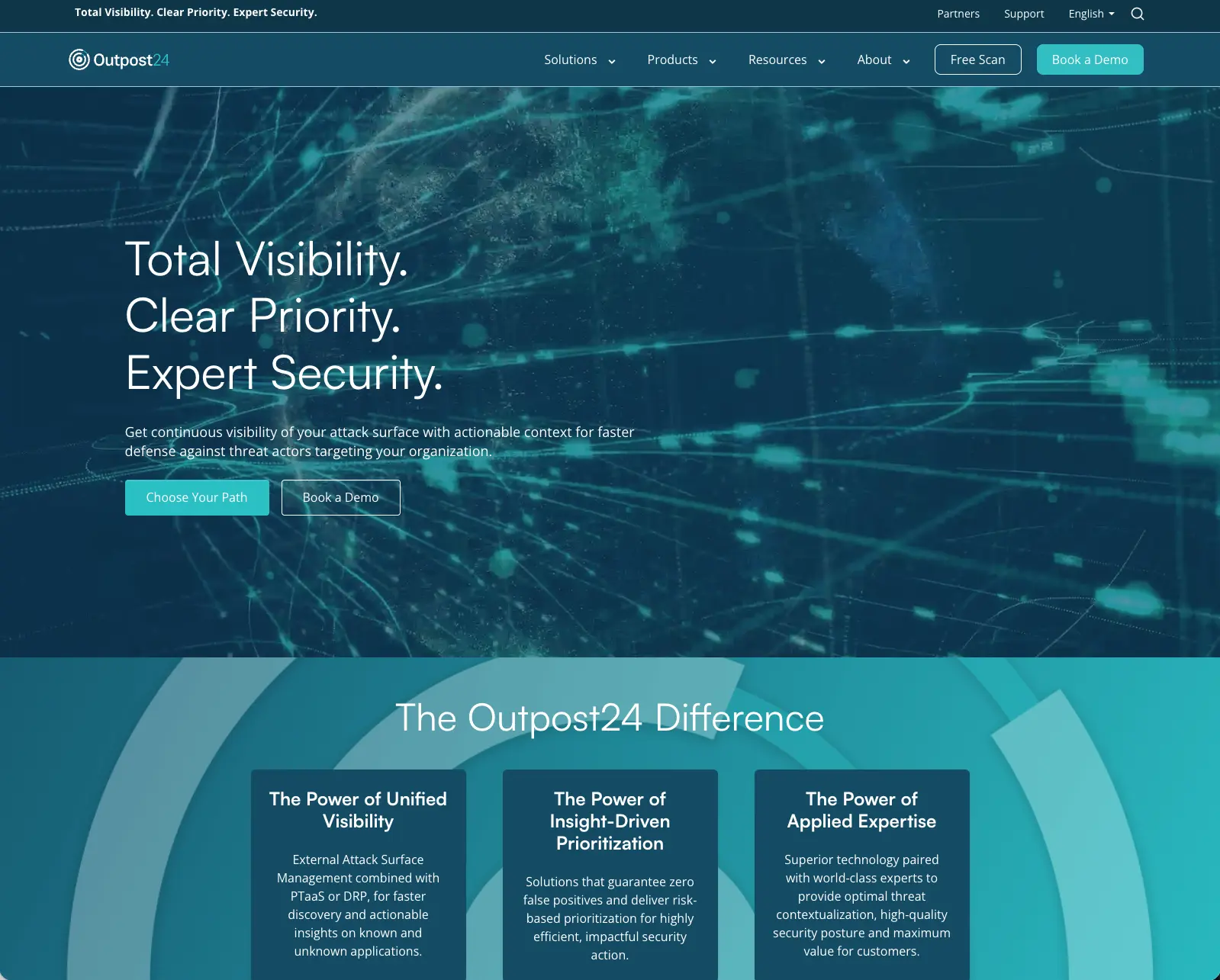
Outpost24 CyberFlex exposure management and PTaaS platform
Headquarters: Stockholm, Sweden / Philadelphia, PA | Founded: 2001 | Best for: Organizations that want a unified exposure management and continuous penetration testing platform with strong European regulatory compliance coverage
Overview
Outpost24 has been a consistent presence in penetration testing for over two decades, and its evolution into a full exposure management platform positions it well for the COST model. Its CyberFlex offering combines External Attack Surface Management with Penetration Testing as a Service in a single annual subscription. It automatically discovers internet-facing assets, continuously monitoring for new exposures, and routing prioritized targets to certified human pentesters.
In the 2025 GigaOm Radar for PTaaS, Outpost24 was named a Challenger and Fast Mover, advancing from the Feature Play quadrant in 2024 to the Maturity and Platform Play quadrant, a meaningful shift that reflects serious investment in integrated, scalable capabilities. The platform integrates directly with Jira and ServiceNow, includes zero-false-positive verification by certified testers, and supports compliance frameworks including PCI DSS, ISO 27001, NIS2, and DORA.
Outpost24’s 2025 addition of AI penetration testing covering LLMs, RAG pipelines, agentic systems, and OWASP Top 10 for LLMs is one of the more thorough AI-specific testing capabilities currently available from any PTaaS provider.
Strengths:
- CyberFlex bundles ASM and PTaaS in one subscription with a flexible consumption model
- Certified PCI ASV scanning vendor for 20+ years, with deep compliance expertise
- Strong European regulatory coverage: NIS2, DORA, GDPR, ISO 27001
- AI and LLM penetration testing with OWASP-aligned methodology, ahead of most competitors
- Named Challenger and Fast Mover in 2025 GigaOm Radar for PTaaS
Limitations:
- Platform complexity is best suited to organizations with some in-house security maturity; very small teams may find the breadth of the platform overwhelming
- Human tester depth for the most complex adversarial simulations leans more toward application testing than network or red team scenarios
- US-based organizations may prefer US-headquartered providers for compliance or procurement reasons
Best for: Mid-market and enterprise organizations, particularly those in regulated industries or with European operations, that want a unified exposure management and continuous PTaaS platform with proven compliance credentials.
4. Synack
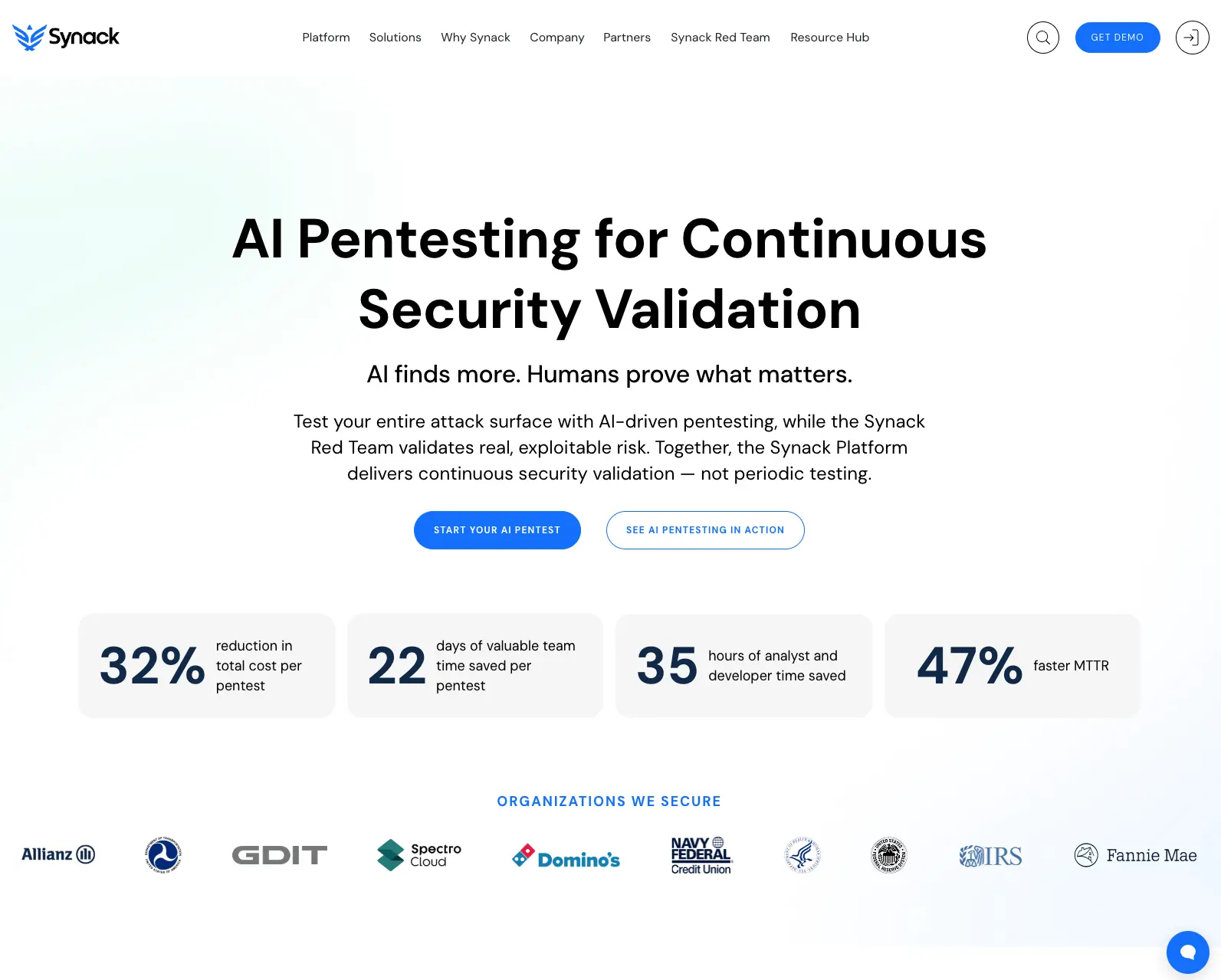
Synack Red Team platform combining AI and vetted security researchers
Headquarters: Redwood City, CA | Founded: 2013 | Best for: Government agencies, defense contractors, and large enterprises requiring continuous testing at scale with strict operational security controls
Overview
Synack operates a unique model: a highly vetted global community of security researchers (the Synack Red Team, or SRT) combined with a secure, controlled testing environment and AI augmentation. In November 2025, Synack introduced Sara Pentest, an agentic AI system built on its Autonomous Red Agent architecture, to direct and accelerate vulnerability discovery alongside its human researchers.
The platform is FedRAMP Moderate Authorized, making it one of the few CPTaaS providers qualified for federal and defense use cases. Synack’s Synack365 offering provides continuous testing coverage for organizations ready to move beyond point-in-time assessments. Fewer than 10% of applicants are accepted to the SRT, among the strictest researcher vetting standards in the industry.
Synack earns high marks from GigaOm for scalability, customizable testing methodologies, and crowdsourcing capabilities, and is rated exceptional for cost value relative to the quality of its offering.
Strengths:
- FedRAMP Moderate Authorization, uniquely qualifying it for federal and defense use cases
- Among the strictest researcher vetting in crowdsourced security
- Sara agentic AI continuously directs researchers toward highest-value targets
- Continuous coverage available through Synack365 for always-on programs
- Rated a GigaOm Leader with strong scalability and flexibility scores
Limitations:
- Premium pricing and engagement overhead exceed what most mid-market organizations can absorb
- Crowdsourced model, even with strict vetting, provides less continuity on a given environment than dedicated-team models
- Platform complexity and commercial structure favor large, mature security programs
Best for: Federal agencies, defense contractors, financial institutions, and large enterprises with complex, continuously-changing attack surfaces that benefit from a broad, controlled research community.
5. Horizon3.ai (NodeZero)
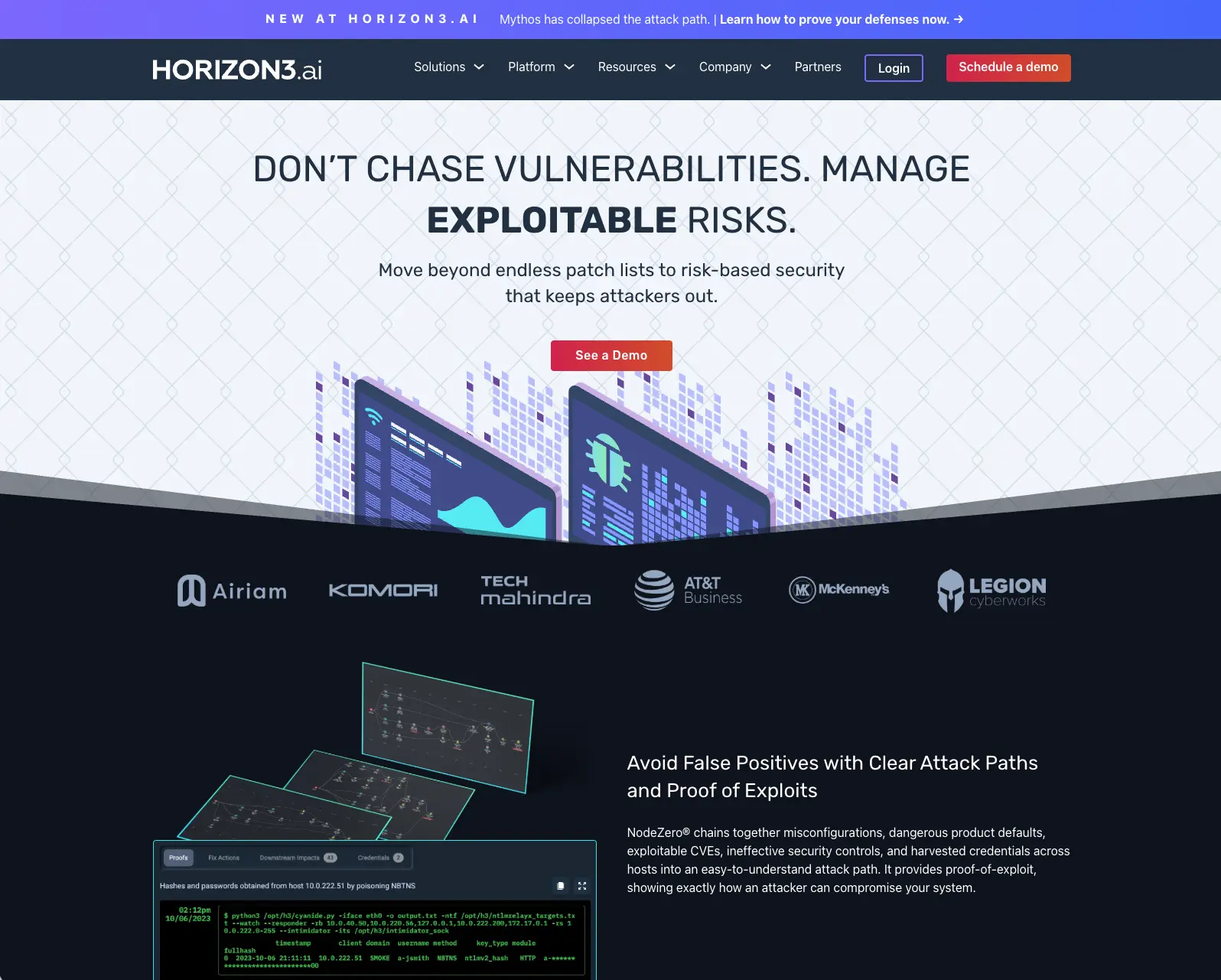
Horizon3.ai NodeZero autonomous penetration testing platform
Headquarters: San Francisco, CA | Founded: 2019 | Best for: Security and IT teams that want autonomous, continuous security validation they can run themselves, without scheduling or waiting for an external team
Overview
Horizon3.ai’s NodeZero platform takes a fundamentally different approach to continuous testing: fully autonomous, self-directed pentesting that runs without human testers. Organizations deploy NodeZero and it autonomously discovers assets, chains together weaknesses the way a real attacker would, provides proof of exploitation, and prioritizes remediation by business impact rather than CVSS score.
In August 2025, NodeZero became the first AI system to fully solve the Game of Active Directory (GOAD), a respected industry benchmark for Active Directory exploitation, completing the challenge in 14 minutes. The platform covers internal networks, external attack surfaces, cloud environments (including lateral movement from on-prem into Azure and GCP), web applications, and credential security. NodeZero’s High-Value Targeting (HVT) engine identifies domain controllers, privileged accounts, and critical infrastructure first, so testing reflects how real adversaries actually prioritize their attacks.
Gartner recognizes Horizon3.ai in its vendor landscape for Adversarial Exposure Validation (AEV), the category that represents automated, continuous security validation at scale. This positions NodeZero differently from traditional PTaaS, as it is a continuous validation layer that security teams can operate themselves on a daily, weekly, or on-demand basis.
Strengths:
- Fully autonomous: no scheduling, no waiting, no external team required to initiate
- Agentless deployment; safe to run in live production environments
- Chains exploits like a real attacker, providing proof-of-exploitation (not just vulnerability discovery)
- 1-click verify to confirm fixes immediately after remediation
- Gartner AEV vendor recognition; first AI to solve GOAD benchmark
Limitations:
- Autonomous-only approach cannot replace human creativity for complex business logic flaws, multi-step social engineering, or bespoke adversarial simulation
- Compliance frameworks that require a named human pentester and attestation letter will need a separate human-led engagement
- Best understood as a continuous validation layer that complements, rather than replaces, a human-led CPTaaS program
Best for: Security and IT teams that want to run continuous, self-directed security validation on their own cadence (daily, weekly, or triggered by changes) and use it to validate fixes, test before deployments, and maintain continuous posture visibility between human-led assessments.
6. BreachLock
BreachLock unified penetration testing platform with hybrid automated and manual testing
Headquarters: New York, NY | Founded: 2019 | Best for: Compliance-driven organizations seeking a hybrid automated/manual model with transparent pricing and fast turnaround
Overview
BreachLock has become one of the most credentialed mid-market CPTaaS providers, holding CREST accreditation and consistent Gartner Hype Cycle recognition as a PTaaS sample vendor since 2021. The BreachLock Unified Platform integrates PTaaS, ASM, and red team capabilities and has completed over 30,000 penetration tests across 20+ countries for clients including BOSCH, NHS, DocuSign, and EY.
In January 2026, BreachLock launched an agentic AI layer extending automated testing to web application attack surfaces. Tests can be scheduled within one to two business days, and BreachLock publishes its pricing structure, a meaningful differentiator in a market where most competitors require a full sales cycle before sharing any cost information.
In the 2025 GigaOm Radar for PTaaS, BreachLock earns high scores for built-in vulnerability scanners, customizable testing methodologies, retesting of findings, and streamlined procurement. It is rated as delivering exceptional risk reduction.
Strengths:
- CREST-accredited; consistent Gartner recognition for PTaaS
- Published pricing with no lengthy sales cycle required to understand cost
- Hybrid automated/manual model with fast scheduling (1 to 2 business days)
- 30,000+ completed engagements; strong compliance documentation
- GigaOm Leader in PTaaS; rated exceptional for risk reduction
Limitations:
- Automation-forward approach may miss the most complex, chained vulnerabilities requiring deep manual expertise
- Less suited to environments with sophisticated multi-stage attack surface requirements
Best for: Compliance-driven organizations, SMBs scaling their security programs, and teams that need a repeatable, cost-predictable hybrid testing model with strong compliance documentation and no pricing surprises.
7. Rapid7
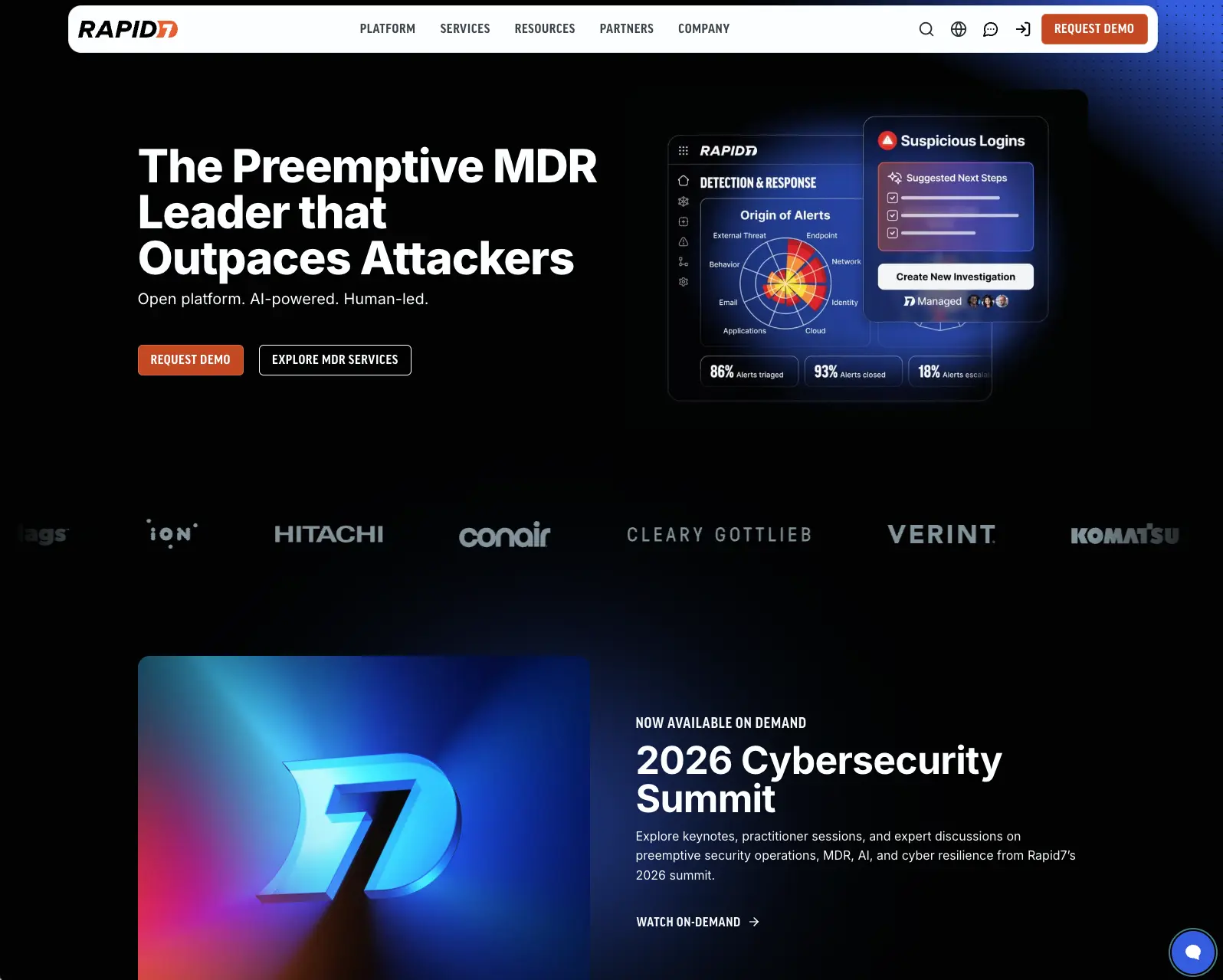
Rapid7 managed penetration testing integrated with Insight Platform
Headquarters: Boston, MA | Founded: 2000 | Best for: Organizations already invested in the Rapid7 ecosystem seeking integrated vulnerability management and penetration testing
Overview
Rapid7 is one of the most recognized names in enterprise cybersecurity, and its managed penetration testing services integrate tightly into the broader Rapid7 Insight Platform. The platform connects penetration testing findings directly into vulnerability management through InsightVM, attack surface visibility through Surface Command, and detection and response capabilities through InsightIDR and MDR services.
Rapid7’s Vector Command offering is its primary continuous security validation solution, typically combining continuous testing, vulnerability management, and attack surface management into a single platform-driven workflow. For organizations already invested in the Rapid7 ecosystem, the integration value can be significant: findings, assets, vulnerabilities, and detection workflows all exist within a centralized operational view.
Rapid7’s research team also contributes to Metasploit, one of the world’s most widely used penetration testing frameworks, bringing strong offensive security credibility and research depth into customer engagements.
Strengths:
- Tight integration between penetration testing, InsightVM vulnerability management, ASM via Surface Command, and detection and response workflows
- InsightVM can also support ASV compliance requirements for organizations managing external exposure and compliance needs
- Research team contributes directly to Metasploit and maintains strong credibility within the offensive security community
- Broad testing coverage across network, application, cloud, and social engineering engagements
- Longstanding enterprise presence with a mature cybersecurity platform and services portfolio
Limitations:
- Penetration testing is one component within a much broader security platform and services ecosystem, which may feel less specialized for organizations seeking a dedicated continuous pentesting relationship
- Customers generally have less direct visibility and interaction with the testers performing engagements compared to more operator-led CPT providers
- Best suited to organizations already invested in the Rapid7 ecosystem, where platform consolidation creates the most operational value
- Organizations seeking a highly collaborative, tester-driven engagement model may prefer more specialized continuous testing vendors
Best for: Mid-to-large enterprises already using Rapid7 products that want to consolidate penetration testing, vulnerability management, attack surface management, and detection and response into a single operational platform.
8. Pentera
Pentera automated security validation platform for continuous posture testing
Headquarters: Boston, MA | Founded: 2015 | Best for: Organizations that want automated, continuous security validation as a persistent layer, as a powerful complement to human-led testing programs
Overview
Pentera is the category leader in Automated Security Validation, a distinct discipline from human-led pentesting. The platform autonomously emulates attacker behavior, safely and continuously, to identify exploitable vulnerabilities, validate remediation, and prioritize findings by real exploitability rather than theoretical severity scores.
In February 2025, Pentera acquired EVA Information Security, expanding its capabilities in AI-focused red teaming and AI infrastructure risk assessment. The company raised a USD 60 million Series D in 2025 to scale its agentless platform. Pentera is recognized in Gartner’s vendor landscape under Adversarial Exposure Validation (the same category as Horizon3.ai) and is a strong choice for organizations that want to validate their defensive controls continuously between human-led engagements.
The key caveat: Pentera is not a standalone replacement for human-led CPTaaS. Complex business logic flaws, chained multi-step attack paths, and social engineering require human creativity that automated platforms cannot replicate. But as a persistent validation layer, it is the benchmark in its category.
Strengths:
- Category leader for automated, continuous security validation
- Agentless, safe to run in live production environments
- Finds and prioritizes exposures by actual exploitability, not scanner scores
- Strong for ransomware readiness validation and AD security testing
- Gartner AEV vendor recognition; actively expanding into AI security testing
Limitations:
- Automated-only; misses complex business logic vulnerabilities, chained exploitation, and social engineering
- Organizations with compliance requirements specifying human-led testing need a separate engagement
- Best deployed as a complement to, not a replacement for, a human-led CPTaaS program
Best for: Organizations with mature security programs that want automated, continuous validation as a persistent layer between human-led pentesting engagements, and to validate remediations in real time rather than waiting for the next scheduled test.
9. HackerOne
HackerOne PTaaS and bug bounty platform with global ethical hacker community
Headquarters: San Francisco, CA | Founded: 2012 | Best for: Organizations seeking both structured PTaaS engagements and ongoing vulnerability discovery from the world’s largest ethical hacker community
Overview
HackerOne is the world’s largest platform connecting organizations with ethical hackers. Its PTaaS offering extends the bug bounty model into structured, compliance-ready penetration testing, giving access to a community of hundreds of thousands of security researchers, offering a breadth and diversity of perspective no in-house or boutique team can match.
HackerOne’s recent Agentic Penetration Testing as a Service capability continuously probes production endpoints and exports findings directly into ticketing systems, narrowing the remediation loop and moving the platform closer to genuine continuous coverage. The combination of formal PTaaS engagements for compliance and ongoing bug bounty programs for continuous discovery makes HackerOne uniquely flexible for different stages of security maturity.
In the 2025 GigaOm Radar for PTaaS, HackerOne earns top scores for API access, streamlined procurement, and crowdsourcing depth, reflecting its strength as a platform-driven discovery engine rather than a traditional testing service.
Strengths:
- Largest global community of vetted ethical hackers, with unmatched discovery diversity
- Dual-mode: structured PTaaS for compliance evidence + ongoing bug bounty for continuous discovery
- Agentic AI capabilities for continuous endpoint testing
- Exceptional GigaOm ratings for API access and procurement simplicity
Limitations:
- Crowdsourced model trades consistency for scale, and tester continuity on a given environment is limited
- Managing inbound findings at volume requires internal security team bandwidth to triage effectively
- Organizations without dedicated security staff may find the community model operationally challenging
Best for: Organizations with established security programs and internal bandwidth to manage a large researcher community, seeking both compliance-ready PTaaS and continuous, researcher-driven vulnerability discovery.
10. Bugcrowd
Bugcrowd crowdsourced security platform with CrowdMatch AI tester matching
Headquarters: San Francisco, CA | Founded: 2011 | Best for: Agile, cloud-native organizations seeking flexible crowdsourced pentesting with AI-matched tester selection
Overview
Bugcrowd is one of the two leading crowdsourced security platforms and has built a differentiated position through its CrowdMatch™ AI engine, matching organizations with researchers best suited to their technology stack, industry, and testing objectives rather than simply assigning by availability.
The Bugcrowd Platform supports multiple programs in a unified interface: managed PTaaS (Next-Gen Pen Test), vulnerability disclosure programs, bug bounty, and attack surface management. Its availability on AWS Marketplace simplifies procurement for cloud-native organizations with committed cloud spend. The platform supports real-time vulnerability triage, Jira and Slack integration, and dynamic scope adjustment, which is useful for organizations with frequently changing environments.
In the GigaOm Radar, Bugcrowd earns top scores for crowdsourcing capability, API access, and customizable testing methodologies, among the highest in the report for the flexibility of its crowdsourced discovery model.
Strengths:
- CrowdMatch AI-driven tester matching, with researchers selected for relevance rather than availability
- Multi-program platform: PTaaS, bug bounty, VDP, and ASM in one interface
- AWS Marketplace availability simplifies cloud-native procurement
- GigaOm Leader; exceptional ratings for crowdsourcing and customizable methodology
Limitations:
- Crowdsourced model means researcher continuity varies across engagements
- Organizations without internal security staff to triage findings may find the volume from active programs challenging to manage
- Not a dedicated-team model; most suitable for discovery at scale rather than deep adversary simulation
Best for: Agile, cloud-native organizations that value researcher diversity and flexible program design, and have the internal bandwidth to triage and act on findings from a large community.
Quick Comparison Table
Provider | Model | True Continuity | Human Testing | ASM Included | Analyst Recognition | Best For |
|---|---|---|---|---|---|---|
Sprocket Security | Dedicated team + platform | ✅ Change-triggered | ✅ Dedicated US testers | ✅ Free tier | Gartner COST vendor (PTaaS + Red Team) | Any org size; true continuous program |
Cobalt.io | Vetted community + AI platform | ✅ Continuous scanning | ✅ 500+ vetted testers | ✅ Included | GigaOm Leader (3 yrs); Gartner Hype Cycle | Mature enterprise programs |
Outpost24 | Expert team + exposure platform | ✅ ASM-integrated continuous | ✅ CREST-certified testers | ✅ CyberFlex bundle | GigaOm Challenger & Fast Mover 2025 | Regulated industries; European compliance |
Synack | Vetted crowd + AI (SRT) | ✅ Synack365 continuous | ✅ <10% acceptance rate | ✅ Included | GigaOm Leader; FedRAMP Authorized | Federal, defense, large enterprise |
Horizon3.ai | Autonomous AI platform | ✅ Always-on, self-directed | ❌ Automated only | ✅ External + internal | Gartner AEV vendor | Self-directed continuous validation layer |
BreachLock | Hybrid automated + manual | ⚡ Recurring + scanning | ✅ CREST-certified testers | ✅ Included | GigaOm Leader; Gartner PTaaS vendor | Compliance orgs; SMBs; published pricing |
Rapid7 | Expert team + Insight platform | ⚡ Vector Command | ✅ Metasploit research team | Via platform | Gartner/IDC enterprise vendor | Existing Rapid7 ecosystem customers |
Pentera | Automated validation | ✅ Always-on automated | ❌ Automated only | Via platform | Gartner AEV vendor | Continuous validation between manual tests |
HackerOne | Crowdsourced + structured PTaaS | ⚡ Bug bounty continuous | ✅ Global researcher community | ✅ Included | GigaOm Leader; top API & procurement scores | Large programs with internal triage capacity |
Bugcrowd | Crowdsourced + managed PTaaS | ⚡ Bug bounty continuous | ✅ CrowdMatch-selected | ✅ Included | GigaOm Leader; top crowdsourcing score | Cloud-native; agile teams |
How to Choose the Right CPTaaS Provider
The right choice depends on five factors. Work through each before shortlisting.
1. What kind of continuity do you actually need?
The most important question. Many vendors use “continuous” to mean “on-demand,” where you still initiate each engagement, the scope is still fixed, and findings still arrive in a report. Ask specifically: does testing trigger automatically when new assets appear or infrastructure changes, or does someone on my team have to kick it off? True change-triggered testing (Sprocket, Cobalt, Synack365, Outpost24 CyberFlex) is meaningfully different from on-demand scheduling.
For teams that want to run their own continuous validation without waiting for an external team, NodeZero (Horizon3.ai) and Pentera offer a self-service layer that runs independently on your chosen cadence.
2. What does your compliance framework actually require?
This matters more than it seems. Some frameworks specifically require human-led penetration testing by qualified individuals, and automated-only platforms will not satisfy these requirements. Before shortlisting, confirm:
- Does your auditor require a named lead tester?
- Do you need a formal attestation letter?
- Which frameworks apply: SOC 2, PCI DSS v4.0, HIPAA, ISO 27001, FedRAMP, DORA, NIS2?
For FedRAMP, Synack’s authorization is a clear qualifier. For PCI DSS with ASV scanning, Outpost24’s 20+ years as a certified PCI ASV vendor is a distinct advantage. For SOC 2, PCI DSS, HIPAA, and ISO 27001, Sprocket, Cobalt, BreachLock, and Outpost24 all provide compliance-ready reporting from live program data.
3. How important is tester continuity?
There is a meaningful difference between a tester who has worked on your environment for months and a researcher encountering it for the first time. Dedicated-team models (Sprocket) provide the strongest continuity. Vetted-crowd models (Synack, Cobalt) offer breadth. Crowdsourced platforms (HackerOne, Bugcrowd) maximize discovery diversity. The right trade-off depends on whether you need deep context on your specific environment or broad coverage across many assets.
4. What is your team’s internal bandwidth?
Crowdsourced platforms and bug bounty programs generate significant finding noise. Organizations without dedicated security staff to triage and prioritize will find this creates more work than it solves. If your team is small, a managed service with pre-prioritized, validated findings (Sprocket, BreachLock, Outpost24) is more practical than a community of hundreds of researchers submitting discoveries in real time. If your team is large and can absorb volume, HackerOne and Bugcrowd offer exceptional discovery breadth.
5. What does total cost of ownership actually look like?
Credit-based models (Cobalt), engagement-based pricing (enterprise consultancies), annual subscriptions (Sprocket, Outpost24 CyberFlex, BreachLock), and crowdsourced platforms all have very different cost curves at scale. Factor in:
- Cost per retest: unlimited retests included (Sprocket, BreachLock) versus billed separately
- Platform fees separate from testing credits
- Internal time required to manage findings, triage reports, and coordinate
- The cost of a missed vulnerability from under-testing
12 Questions to Ask Any CPTaaS Vendor Before You Sign
Most vendor evaluations die in the demo. The platform looks polished, the sales engineer is sharp, and you leave with a proposal but no real clarity on how the service actually works in practice. These twelve questions cut through the marketing to what matters operationally.
On continuity and triggering:
1. What specifically triggers a new testing cycle? If the answer is “you submit a request” or “we schedule quarterly engagements,” the vendor is describing on-demand PTaaS, not CPTaaS. The right answer involves change detection: new assets discovered, infrastructure changes flagged, new CVEs matched to your environment.
2. What is the average time between a change in my environment and the start of a testing cycle? Days are acceptable answers. Weeks are not. This single metric tells you more about operational maturity than any slide deck.
3. How does your platform discover assets I didn’t tell you about? Shadow IT, forgotten subdomains, and acquired infrastructure are where breaches start. If the vendor only tests the scope you define at kickoff, you have the same blind spots you had before.
On human testers:
4. Will the same tester work on my environment consistently, or does it rotate? Tester continuity affects the depth and quality of findings significantly. A tester who returns to your environment for the sixth time finds different things than one encountering it fresh. Dedicated-team models provide this; crowdsourced models generally do not.
5. Where are your testers based, and what are their certifications? OSCP, GPEN, GWAPT, and CREST-certified testers are meaningfully different from self-reported researchers. US-based teams matter for organizations with data sovereignty requirements or government contracts.
6. Can you show me a sample report? The quality of the finding write-up, the specificity of the reproduction steps, and whether remediation guidance is engineer-facing or executive-facing all reveal the actual quality of the testing practice more honestly than any reference call.
On findings and remediation:
7. How do findings reach my team? Real-time delivery to your ticketing system (Jira, ServiceNow) is the right answer. A PDF that arrives at the end of the engagement is the wrong one. Ask specifically whether Jira tickets are created automatically or whether someone on your team has to manually transfer findings.
8. What happens after we fix something? Unlimited retests at the finding level included in the subscription is the right answer. “We can schedule a retest engagement” means you will pay again or wait. For organizations with active development cycles, retest friction directly extends the window of exposure.
9. How do you handle a critical finding discovered at 11pm on a Friday? This question separates vendors with genuine managed-service models from those operating a platform. The answer should include a defined escalation path and a commitment to notify your team immediately, not hold findings for the next business day.
On compliance and reporting:
10. Can you generate a compliance report today, from live program data? The answer reveals whether reporting is a continuous output of the program or a manual deliverable assembled at engagement close. If the vendor needs to “compile the report” rather than generate it on demand, your next audit will involve scrambling.
11. Which frameworks have your reports been accepted under, and by which auditors? SOC 2 Type II, PCI DSS 11.4, HIPAA technical safeguard evidence, and ISO 27001 Annex A each have specific evidence requirements. Ask for examples, not assurances.
On commercial terms:
12. What is out of scope by default, and how does scope expansion work? Every CPTaaS contract has boundaries. The question is whether those boundaries are visible upfront or revealed later as surprise invoices. Specifically ask about: new assets discovered mid-program, additional test types triggered by incidents, and internal network testing versus external-only coverage.
A vendor that answers all twelve cleanly and specifically, without deflecting to the demo or referencing the contract, is worth a second conversation.
Frequently Asked Questions
What is the difference between PTaaS and CPTaaS?
PTaaS (Penetration Testing as a Service) describes a platform-based delivery model that makes pentesting faster, more accessible, and easier to manage than traditional consulting engagements. Gartner’s Innovation Insight on PTaaS describes it as a technology-led model combining automation and human pentesters to increase efficiency over traditional consulting. CPTaaS (Continuous Penetration Testing as a Service) takes this further: testing is ongoing, triggered by change, and never requires the customer to initiate a new engagement. The continuity is built into the service model, not just the platform’s scheduling interface.
What is the difference between CPTaaS and COST?
COST (Continuous Offensive Security Testing) is an analyst-defined framework describing the full program design, covering risk-tiered triggers, sensing layers, multimodal testing methods, and integration with DevSecOps workflows. Gartner defines COST as a trigger-driven model that replaces static compliance-oriented scopes, blending automation, AI, and human expertise. You can see Gartner’s public vendor landscape for this emerging category via their Penetration Testing market overview. CPTaaS is a delivery model. The best CPTaaS providers operationalize the COST framework; not all of them do.
How often should penetration tests run under a CPTaaS model?
Under a true CPTaaS model, testing does not run on a fixed schedule. It triggers based on change. High-risk triggers (new publicly exploitable exposure, major product release, zero-day alert) should complete a testing cycle within 72 hours. Medium-risk changes (pre-production code commits, internal control updates) within seven days. Low-risk routine changes feed into the next automated pipeline cycle. Annual compliance requirements are satisfied by the continuous program, with on-demand reporting available whenever auditors require evidence.
Is automated penetration testing sufficient?
No, not as a standalone approach. Automated platforms like NodeZero and Pentera are valuable for continuous, scalable security validation; they find known vulnerability classes efficiently and can run in production without disruption. But they miss business logic flaws, chained multi-step attack paths, and social engineering vulnerabilities that require human creativity. Most mature security programs use automated validation as a continuous layer and human-led testing for depth, context, and compliance evidence. The GigaOm Radar for PTaaS, which evaluated 16 leading platforms, specifically notes that vendors relying primarily on automation face challenges unless they expand capabilities or integrate deeper human expertise.
What credentials should I look for in a CPTaaS provider?
- CREST accreditation: the global standard for penetration testing quality assurance (held by Cobalt, BreachLock, Outpost24, and Synack)
- Individual tester certifications: OSCP, CEH, GPEN, or equivalent
- Analyst recognition: positions in the GigaOm Radar for PTaaS and Gartner vendor landscapes indicate independent validation of capabilities
- Compliance-framework experience: confirm the vendor’s reports satisfy your specific auditor’s evidence requirements
What is the average cost of a CPTaaS program?
A basic web application engagement from a mid-market PTaaS provider typically starts around $4,200 to $15,000 for a one-time assessment. Annual CPTaaS subscription programs range from $20,000 to $100,000+ depending on attack surface size and testing frequency. Unlimited-retest subscription models (Sprocket, BreachLock) typically provide better total cost of ownership for organizations with active development cycles than credit-based models where retests are billed separately.
Does a CPTaaS program satisfy compliance requirements for annual penetration testing?
Yes. A continuous program that includes scheduled human-led penetration testing satisfies annual test requirements for SOC 2, PCI DSS, HIPAA, and ISO 27001, while providing continuous coverage between formal assessments. The NIST Cybersecurity Framework emphasizes continuous monitoring and detection as foundational to resilience, a principle CPTaaS operationalizes directly. Providers like Sprocket generate on-demand compliance reports from live program data, so you can satisfy auditors at any point in the year rather than scrambling before your annual assessment date.
The Bottom Line
The case for continuous penetration testing is no longer theoretical. Organizations that test once a year are operating with up to 345 days of untested exposure, in an environment where attackers move in hours and new assets appear without notice. The vendors on this list represent the strongest options in CPTaaS as of 2026, each with a different model, strength profile, and ideal customer profile.
For organizations that want the most genuine form of continuous testing (change-triggered, always-on, backed by dedicated expert testers who know your environment, with free ASM to start), Sprocket Security is the benchmark.
The one wrong answer is staying on annual pentests.
Sprocket Security is a technology-powered continuous penetration testing platform headquartered in Madison, WI. We’ve been continuous since 2018. Start with free Attack Surface Management →