

Penetration Testing as a Service (PTaaS) has become one of the most popular ways for organizations to modernize their security testing programs. Faster results, cleaner reporting, and collaborative platforms have made PTaaS an attractive alternative to traditional point-in-time penetration tests.
But there’s a growing misconception in the market that needs to be addressed head-on: PTaaS is not continuous security testing.
And misunderstanding that difference can leave organizations with blind spots they don’t realize exist. In this post, we will break down why PTaaS is not continuous, why that distinction matters, and what organizations should be thinking about next as they mature their security testing programs.
What Is PTaas?
PTaaS (Penetration Testing as a Service) is a modern delivery model for penetration testing that replaces traditional, report-only engagements with a more collaborative and transparent testing experience.
A typical PTaaS engagement includes:
- A defined testing window. Testing occurs during a fixed-period based on a pre-agreed scope and schedule.
- Human-led offensive testing. Skilled testers manually identify, chain, and validate vulnerabilities using real attacker techniques rather than relying solely on automated scanners.
- A shared platform for findings and communication. Vulnerabilities are surfaced in near real-time, allowing security and engineering teams to view evidence, ask questions, and prioritize remediation as testing is underway.
- Faster retesting and remediation workflows. Fixes can be validated quickly without waiting for a new report cycle, reducing friction between discovery and remediation.
In practice, PTaaS significantly improves visibility, speed, and collaboration compared to traditional penetration tests that deliver results weeks later in a static PDF.
However, while PTaaS modernizes how penetration testing is delivered, it does not fundamentally change when testing occurs.
PTaaS engagements are still:
- Scoped in advance
- Bound to a fixed timeframe
- Representative of a single snapshot of risk
Once the testing window closes, active adversarial testing stops, regardless of how much the environment continues to change. That distinction is critical, because in modern environments, change is constant.
Why PTaaS Feels “Continuous” (But Isn’t)
PTaaS platforms often emphasize live dashboards, in-progress findings, retesting on demand, and ongoing platform access. These features can feel continuous, especially compared to traditional pentests that disappear for weeks and return as a PDF report.
However, under the marketing language, PTaaS still operates on a familiar model: A defined scope, tested during a defined period, by humans, at a specific point in time.
Once the engagement ends:
- New code isn’t tested
- New infrastructure isn’t evaluated
- Newly introduced vulnerabilities aren’t discovered
- Configuration drift goes unseen
The environment continues to change but testing stops.
The Core Limitation: Time Gaps
Modern environments change constantly:
- Code is deployed regularly
- Cloud infrastructure scales up and down dramatically
- Dependencies update silently
- Feature flags expose new attack paths
- Permissions and identities shift over time
A PTaaS engagement, even one run quarterly, creates time gaps where no adversarial testing is happening. Those gaps matter because attackers don’t wait for your next engagement window.
Why This Matters More Than Ever
- Attackers Operate Continuously
Threat actors don’t attack “once per quarter.” They probe continuously, looking for missed edge cases, incomplete remediations, or newly introduced vulnerabilities. A vulnerability introduced the day after a PTaaS engagement ends may remain exploitable for months. From an attacker’s perspective, that gap is an opportunity.
- Security Teams Assume Coverage That Doesn’t Exist
One of the most dangerous outcomes of PTaaS marketing language is false confidence. Security leaders may believe “We have ongoing coverage,” or “Our attack surface is being monitored routinely.” When in reality only known scope or a snapshot was tested and during a narrow time window. That gap between perception and reality is where risk accumulates.
- Compliance Does Not Mean Continuous Security
PTaaS is excellent for regulatory requirements, audit readiness, proving testing occured, or demonstrating remediation workflows. But compliance-driven testing schedules are rarely aligned with real-world attack timing. Checking the box does not equal reducing exposure.
PTaaS Solves Real Problems (Just Not This One)
To be clear: this isn’t an argument against PTaaS. PTaaS delivers meaningful improvements over traditional pentesting. Better collaboration between testers and engineers, faster feedback loops, cleaner evidence for auditors, and more efficient remediation tracking.
PTaaS is an evolution in delivery. What it isn’t is an evolution in coverage over time.
The Question Security Teams Should Be Asking
Instead of asking:
“Do we use PTaaS?”
The more important question is:
“What happens between our PTaaS engagements?”
If your answer is “We hope nothing changes,” or “We wait until the next test.” Then there is a measurable risk gap, no matter how good the PTaaS platform is.
From Point-in-Time to Always-On Thinking
Security programs tend to mature in stages:
- Annual pentests
- PTaaS for faster, better point-in-time testing
- Recognition that environments change faster than testing cycles
- A need for adversarial testing that keeps pace with change
PTaaS often sits squarely in stage two. The next stage requires a different model. One that treats adversarial testing as an ongoing capability, not an event.
What Comes After PTaaS?
This is where many teams start exploring concepts like continuous penetration testing (CPT) alongside always-on attack surface testing or human-in-the-loop continuous security testing. Each of these approaches attempts to answer the same underlying question: How do we identify exploitable risk as it appears?
The Next Evolution
If PTaaS helped modernize how penetration testing is delivered, Continuous Penetration Testing (CPT) exists to modernize when and how often adversarial testing actually happens.
CPT is designed for environments that:
- Change daily
- Deploy faster than testing cycles
- Expose new attack paths as changes are introduced
Rather than asking “When is our next test?” CPT shifts the question to “What is exploitable in our environment right now?” That mindset change is becoming essential as attack surfaces grow and release cycles accelerate.
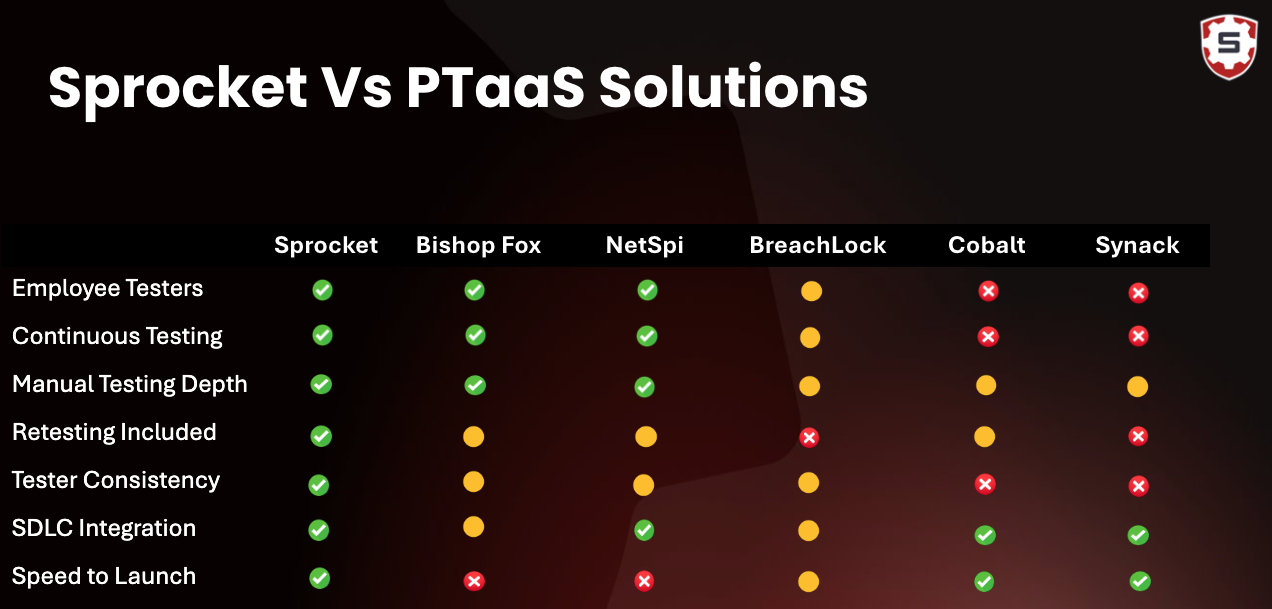
Sprocket Security’s approach to CPT is built specifically to address these gaps, combining ongoing adversarial testing with human expertise to surface exploitable risk as environments change.
What Security Leaders Should Do Next
If your organization currently relies on PTaaS, the next step isn’t to abandon it. It’s to understand its limits and evaluate what fills the gaps between engagements.
“What changes in our environment go untested today?”
“How long would a newly introduced vulnerability remain undiscovered?”
“Do we have any adversarial signal between formal test windows?”
If those questions are uncomfortable, that’s a sign. Continuous Penetration Testing builds on the strengths of PTaaS while addressing its biggest blind spot: time.
For teams ready to move beyond snapshots and toward always-on adversarial validation, CPT represents the next stage of maturity.
Now is the right time to start evaluating whether point-in-time testing, no matter how well delivered, can keep pace with both how your environment changes and how the threat landscape continues to mature.
Curious what comes after PTaaS? See how continuous penetration testing works in practice and how teams are using it to close the gaps between tests.