
A data breach involving protected health information (PHI) is never just a security problem — it’s the starting gun for a federal investigation. When HHS’s Office for Civil Rights (OCR) comes knocking, it isn’t asking whether you had a bad day. It’s asking whether you had a defensible security program. For healthcare organizations and their business associates, knowing what OCR scrutinizes after a breach can be the difference between a corrective action plan and a multi-million dollar penalty.
This post breaks down the specific areas OCR investigators examine, what they expect to find, and how a continuous penetration testing program can demonstrate the proactive posture regulators increasingly demand.
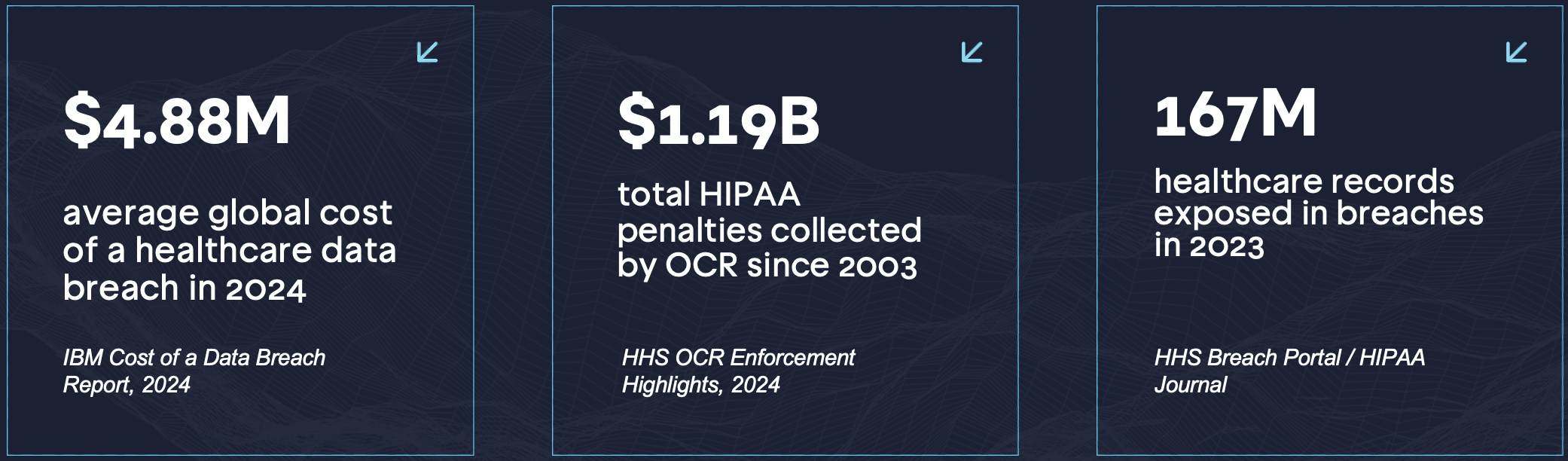
By the Numbers
Why OCR Investigations Begin Where They Do
Under the HIPAA Security Rule, covered entities and business associates are required to conduct regular risk analyses, implement appropriate safeguards, and document those activities. OCR’s post-breach investigations are essentially an audit of whether those obligations were met — before the breach occurred. Investigators aren’t just looking at what happened; they’re looking at what you knew, what you did about it, and how you can prove it.
According to the Ponemon Institute’s 2024 Cost of a Data Breach Report, organizations with mature security programs — including automated vulnerability detection and regular penetration testing — contained breaches an average of 86 days faster than those without. In the eyes of OCR, speed of detection and containment is evidence of a functional security program.
“OCR’s investigation focuses less on the breach itself and more on the gaps in your security program that made the breach possible — and whether those gaps were known or knowable.”
— HHS Office for Civil Rights, HIPAA Enforcement Guidance
8 Areas OCR Investigators Focus On
- Risk Analysis Documentation — Was a thorough, organization-wide risk analysis conducted and updated regularly? OCR will ask for it on day one.
- Access Controls — Were unique user IDs, emergency access procedures, and automatic logoff controls in place and enforced?
- Audit Logging & Monitoring — Were audit controls implemented to record activity on systems containing PHI? Were logs reviewed?
- Workforce Training — Did staff receive HIPAA security training? Were policies in place against unauthorized PHI access?
- Transmission Security — Was PHI encrypted in transit? Were technical safeguards applied to guard against unauthorized access?
- Patch Management & Vulnerability Management — Were known vulnerabilities identified and remediated in a timely manner? Can you prove it?
- Business Associate Agreements — Were BAAs executed with all vendors handling PHI? OCR will trace the breach to third-party relationships.
- Incident Response Planning — Was a formal incident response and breach notification procedure documented, tested, and followed?
Sources: HHS OCR Investigation Protocols; HIPAA Security Rule 45 CFR §164.308–164.316
The Vulnerability Management Question
One of the most revealing areas of any OCR investigation is vulnerability management. Investigators will ask: Did you know this system was exposed? When did you last test it? What did you find, and what did you do about it?
This is where the gap between an annual penetration test and a continuous testing model becomes painfully visible. The average time to exploit a newly disclosed vulnerability is just five days, yet the average annual pentest window is only 20 days — leaving 345 days of the year completely untested. OCR’s enforcement record shows a consistent pattern: organizations that relied on point-in-time assessments failed to detect the vulnerabilities that attackers ultimately exploited.
The kinds of findings Sprocket’s testers routinely uncover during continuous engagements — unauthenticated API endpoints exposing tens of thousands of patient records, memory disclosure vulnerabilities on unpatched appliances, cleartext credentials on accessible file shares — each represent a potential enforcement action waiting to happen. Not because of the finding itself, but because it demonstrates the organization failed to identify and remediate a knowable risk.
What “Reasonable Safeguards” Actually Means
HIPAA doesn’t mandate perfection — it requires “reasonable and appropriate” safeguards based on the size, complexity, and capabilities of the organization. But OCR has made clear through enforcement actions that “reasonable” is a high bar. A 2023 settlement with a major healthcare system resulted in a $4.75 million penalty after OCR found that despite a prior enforcement action, the organization still lacked adequate access controls and audit logging. Repeat findings carry significantly heavier penalties.
Reasonableness, in OCR’s view, increasingly means proactive — not reactive. Organizations that can demonstrate they were actively looking for vulnerabilities, tracking remediation, and retesting fixes present a materially stronger defense than those who only learned of a problem when a breach occurred.
How Continuous Penetration Testing Reduces OCR Exposure
The most effective way to prepare for an OCR investigation is to make sure the evidence of a functioning security program exists before any investigation begins. Continuous penetration testing addresses this directly by creating a documented, ongoing record of your security posture — findings, remediation timelines, retest confirmation, and tester narratives — all time-stamped and auditable.
Unlike a point-in-time report that goes stale the moment it’s printed, a continuous program tracks changes to your attack surface in real time. New assets are discovered and tested. Newly disclosed CVEs are evaluated against your environment within days, not months. When OCR asks “when did you last test this system?” you have a specific, documented answer — with proof.
“Organizations with continuous security testing programs reduced the average breach lifecycle by 86 days compared to those relying on periodic assessments — translating directly to lower regulatory exposure and lower remediation costs.”
— Ponemon Institute / IBM, Cost of a Data Breach Report 2024
Key Takeaways for Security Leadership
If your organization handles PHI and a breach occurs, the OCR investigation will focus on whether your security program was genuinely operational — not just documented on paper. The organizations that fare best are those that can produce contemporaneous evidence of risk analysis, vulnerability management, access control enforcement, and ongoing testing activity.
Annual penetration tests are not enough. The regulatory and threat landscape has moved beyond a once-a-year snapshot. A continuous testing model — one that integrates attack surface monitoring, human-driven testing triggered by changes, and an always-on remediation workflow — is both the defensible posture regulators expect and the operational model that actually reduces breach risk.
The question isn’t whether OCR might investigate your organization. Given breach volumes and enforcement trends, the question is whether you’ll be able to demonstrate that your security program deserved a favorable outcome.
Ready to build the audit trail OCR expects — before an investigation begins?Learn more at sprocketsecurity.com or reach out at contact@sprocketsecurity.com.